
The Ultimate Guide to ERPNext Implementation in India: Everything You Need to Succeed
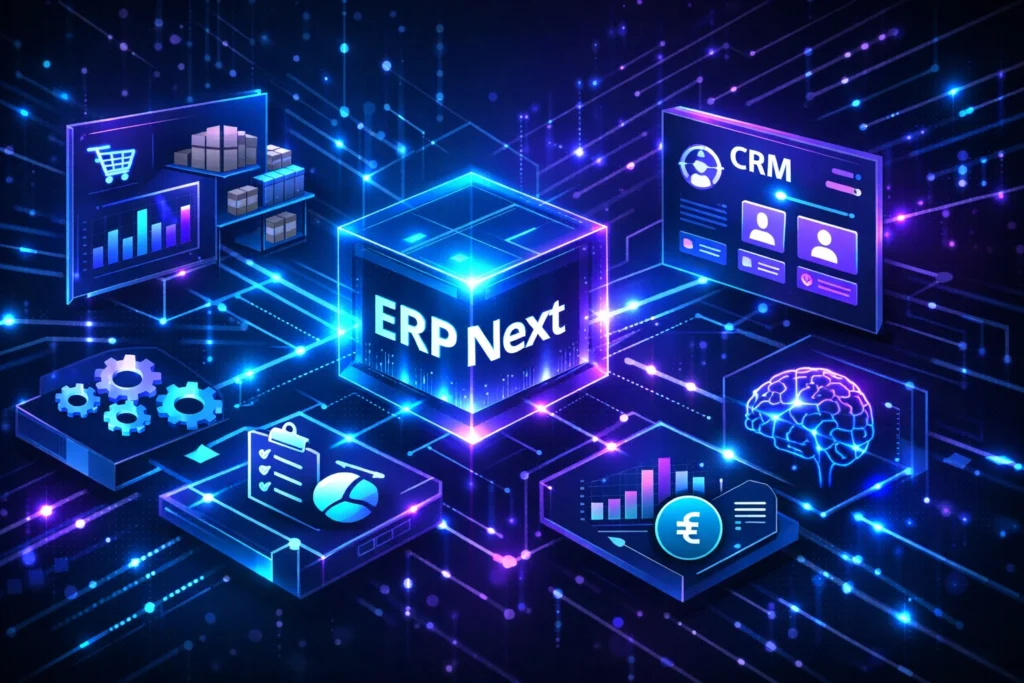
For many Indian enterprises, growth eventually hits a structural ceiling. As a company expands from a small team to a multi-departmental organization, the reliance on fragmented spreadsheets, disconnected legacy software, and manual data entry creates operational friction. When inventory levels in the warehouse don't match the sales team's CRM, or when GST reconciliation becomes a week-long manual ordeal, the business isn't just slowing down: it is losing revenue through invisible leaks.
At Unwavering Technology, we view these challenges not as software problems, but as system failures. Fragmented data leads to poor decision-making. ERPNext offers a unified architectural solution that integrates every facet of an organization: from procurement and manufacturing to HRMS and finance: into a single source of truth.
This guide outlines the strategic framework for a successful ERPNext implementation in the Indian context, ensuring your transition from chaos to operational clarity is both measurable and scalable.
Why ERPNext is the Strategic Choice for Indian Enterprises
In the Indian market, the choice of an ERP often boils down to a trade-off between expensive, rigid global platforms like SAP or Oracle and local, low-cost solutions that lack scalability. ERPNext disrupts this binary. It provides enterprise-grade functionality at a fraction of the cost, bolstered by a robust open-source community and native support for Indian regulatory requirements.
As an ai development company india, we've observed that businesses implementing ERPNext see an average of 35% increase in operational efficiency within the first year. The platform’s flexibility allows us to build custom AI solutions directly into the ERP workflow, enabling predictive inventory management and automated financial forecasting.
Key Advantages for the Indian Market:
- GST and Compliance Ready: Native integration for GST tax applications, e-invoicing, IRN generation, and GSTR reporting ensures you remain compliant without third-party add-ons.
- No Per-User Licensing: Unlike traditional SaaS ERPs that penalize growth with per-user fees, ERPNext allows you to scale your workforce without increasing software costs.
- Mobile-First Operations: The responsive PWA (Progressive Web App) allows factory floor managers and field sales agents to update data in real-time from any location.

The Core Modules Driving Operational Visibility
A successful implementation starts with identifying which modules will provide the highest immediate ROI. ERPNext is modular by design, allowing for a phased rollout that doesn't overwhelm the organization.
1. Finance and Accounting
The backbone of any ERP, this module automates the "order-to-cash" and "procure-to-pay" cycles. It handles multi-currency transactions, cost center budgeting, and automated TDS calculations. For Indian firms, the integration with the India Compliance app simplifies the generation of e-way bills and e-invoices directly from the sales invoice screen.
2. Manufacturing and Inventory
For the manufacturing sector, ERPNext provides a comprehensive Bill of Materials (BOM) management system, work order tracking, and shop floor management. It eliminates "stock-outs" by using automated reorder level triggers. When integrated with custom AI agents, the system can even predict demand surges based on historical data.
3. HRMS and Payroll
Managing a workforce in India requires navigating complex payroll structures, including EPF, ESI, and Professional Tax. The HRMS module automates attendance through biometric integration, manages leave policies, and generates compliant salary slips with a single click.
4. CRM and Sales
A unified CRM ensures that the sales pipeline is visible to the entire management team. By connecting your CRM with WhatsApp AI bots, you can automate lead capture and status updates, ensuring no prospect falls through the cracks.
The Unwavering Implementation Framework
Implementation is where 95% of technology projects face hurdles. Most failures aren't due to the software itself, but due to poor process mapping and lack of user adoption. We follow a structured, five-phase deployment model engineered to mitigate risk.
Phase 1: Discovery and Business Process Mapping
We begin by auditing your existing workflows. This isn't just about what software you use, but how data moves from Department A to Department B. We identify "bottlenecks": those manual approval steps or redundant data entries that slow down the business.
Phase 2: Architecture and Configuration
During this phase, we configure the ERPNext environment. This involves setting up the Chart of Accounts, defining naming series, and configuring user roles and permissions. As an ecommerce development company india, we often integrate ERPNext with existing sales channels to ensure a unified inventory view.
Phase 3: Custom Development and Integration
While ERPNext is comprehensive, most enterprises require specific customizations. Whether it’s a unique print format for invoices or a custom API integration with a Shopify store, this phase ensures the software adapts to the business, not the other way around.
Phase 4: Data Migration and Cleansing
Migrating from legacy systems like Tally or manual Excel sheets requires precision. We execute a multi-step migration process:
- Data Extraction: Pulling records from legacy databases.
- Data Cleansing: Removing duplicates and correcting formatting errors.
- Validation: Ensuring opening balances match exactly before the "Go-Live" date.
Phase 5: Training and Hypercare
Software is only as good as the people using it. We conduct departmental training sessions followed by a "Hypercare" period where our engineers are on standby to resolve any initial friction during the first month of live operations.

Integrating ERPNext with Your eCommerce Ecosystem
In 2026, an ERP cannot exist in isolation. For retail and D2C brands, the ERP must be the "brain" that controls various sales limbs. If you are working with a shopify development company to build your storefront, the integration with ERPNext is non-negotiable.
When a customer places an order on Shopify, the ERP should automatically:
- Create a Sales Order.
- Check warehouse inventory across multiple locations.
- Trigger a delivery note for the logistics team.
- Update the accounting ledger and generate a GST-compliant invoice.
Without this connection, more sales simply create more operational chaos. We specialize in building these bridges, ensuring that your eCommerce architecture is fully synchronized with your back-office operations.
Investment and Timeline: What to Expect
Understanding the financial and time commitment is crucial for planning. In India, ERPNext implementations generally fall into three categories:
| Implementation Scale | Typical Duration | Focus Areas |
|---|---|---|
| SME / Trading | 4–8 Weeks | Finance, Sales, Buying, Inventory |
| Manufacturing | 3–5 Months | BOM, Work Orders, Shop Floor, Quality Control |
| Enterprise / Custom | 6–12 Months | Multi-company, Custom AI Modules, Complex Integrations |
The cost of implementation in India typically starts from ₹1,50,000 for standard setups and can scale significantly for enterprise-level custom deployments. However, when compared to the recurring annual licensing fees of proprietary ERPs, the ROI of ERPNext is often realized within the first 14–18 months.
Common Pitfalls: Why 95% of AI and ERP Projects Fail
It is a sobering statistic that 95% of AI and automation projects fail to meet their original objectives. ERP implementations often fall into the same trap for three specific reasons:
- Scope Creep: Trying to automate everything at once instead of prioritizing high-impact modules.
- Lack of Leadership Buy-in: An ERP is a cultural shift, not just an IT project. It requires the mandate of the CEO and department heads.
- Poor Data Quality: Migrating "dirty data" into a new system only results in a faster version of the old problems.
To succeed, we recommend a "Minimum Viable ERP" approach: getting core modules live and stable before layering on advanced automations like AI-driven matchmaking or complex workflow orchestrations.
Building a Future-Proof Operation
The goal of implementing ERPNext isn't just to replace Tally or Excel; it's to build a foundation for the future of your business. With a centralized data lake, you can begin to leverage advanced technologies like AI agents to handle repetitive tasks.
For instance, by integrating the Evolution API and n8n, you can allow your customers to check their order status or request quotes directly via WhatsApp, with the data being pulled and pushed in real-time from your ERPNext backend.
At Unwavering Technology, we don't just sell software features; we engineer systems that drive revenue and reduce operational drag. Whether you are a manufacturer in Gujarat, a logistics firm in Maharashtra, or a D2C brand in Bangalore, the right ERP implementation is the catalyst for your next stage of growth.
Is your business ready to move beyond manual processes and embrace operational excellence?
Book a free consultation with our ERP and Automation experts at Unwavering Technology to discuss your implementation roadmap.
Leave a Reply