
The Ultimate Guide to AI-Powered eCommerce Solutions: Everything You Need to Succeed in 2026
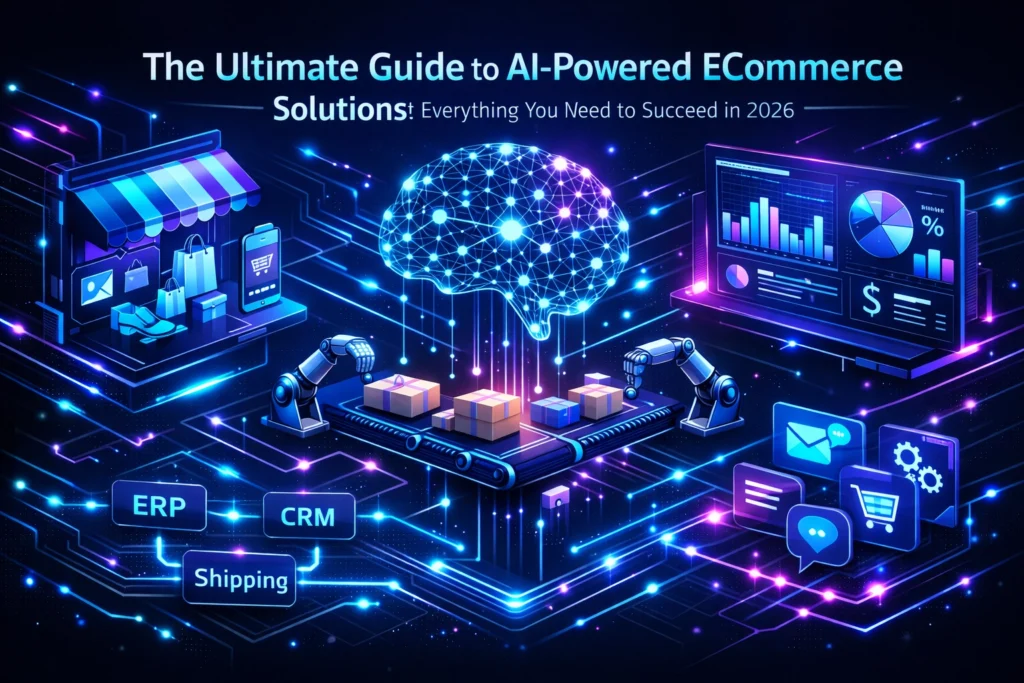
By April 2026, the distinction between "eCommerce" and "AI-powered commerce" has effectively vanished. For global retailers and Indian enterprises alike, AI is no longer a peripheral experiment or a marketing buzzword: it is the foundational infrastructure. Operating a store without deep AI integration today is equivalent to running a warehouse without electricity.
As a leading AI development company in India, we have observed a structural reset in how value is created online. The industry has moved past basic chatbots and generic recommendations into the era of agentic workflows and autonomous supply chains. This guide outlines the strategic architecture required to dominate the digital shelf in 2026.
The Cost of Static Infrastructure: Why Traditional eCommerce is Failing
The primary challenge facing modern retailers isn't a lack of traffic; it is the inefficiency of the "static" storefront. Traditional websites force customers to act as their own navigators, filtering through thousands of SKUs to find a specific solution. This friction results in abandoned carts and soaring customer acquisition costs (CAC).
In 2026, competitiveness hinges on operational agility and data quality. When customer intent, inventory levels, and fulfillment logistics are not connected in a real-time feedback loop, every increase in sales creates an equal increase in operational chaos. To scale without breaking your margins, you must transition from a passive website to an active, intelligent ecosystem.
1. Intent-Driven Product Discovery: The Rise of Shopping Agents
The traditional search bar is being replaced by AI Shopping Agents. Unlike legacy search engines that rely on keyword matching, intent-driven agents understand context, nuance, and user goals.
Instead of searching for "waterproof running shoes," a customer in 2026 asks, "What should I wear for a rainy marathon in London next month?" The AI agent processes the weather data, the technical requirements of the activity, and the customer’s previous brand preferences to curate a personalized kit.
We integrate these capabilities into platforms via robust RAG (Retrieval-Augmented Generation) pipelines. By connecting your product catalog to large language models, we enable:
- Conversational Filtering: Reducing the "time-to-cart" by allowing users to describe their needs naturally.
- Hyper-Personalization: Utilizing real-time data to boost conversion rates by up to 23% through predictive modeling.
- Visual Search and Recognition: Allowing customers to upload photos and find matching or complementary products instantly.

2. WhatsApp Automation: Turning Conversations into Transactions
In regions like India and parts of Europe, the website is often secondary to the chat interface. For many brands, the most profitable sales channel is now the automated chat window.
As an expert eCommerce development company in India, we specialize in deploying advanced WhatsApp AI bots that do more than just answer FAQs. These agents are engineered to handle the entire "order-to-delivery" flow within the chat app.
- Catalog Browsing: Synchronized real-time with your Shopify or Magento store.
- Automated Checkout: Integrated payment links that complete the transaction without the user leaving the app.
- Post-Purchase Support: Automated tracking updates and resolution of 80% of common support tickets, such as "Where is my order?" (WISMO).
This shift toward conversational commerce ensures that your brand is available 24/7, providing instant gratification that a static contact form cannot match.
3. Autonomous Supply Chain and Inventory Orchestration
The most significant AI breakthroughs in 2026 are happening behind the scenes. Operational visibility is the difference between a profitable quarter and a logistical nightmare.
Agentic AI systems now independently forecast demand by analyzing social media trends, local weather patterns, and historical sales data. We build custom integrations that allow these AI agents to:
- Rebalance Inventory: Automatically moving stock between warehouses to meet localized demand spikes.
- Reroute Shipments: Optimizing logistics in real-time to avoid disruptions in the supply chain.
- Predictive Procurement: Generating purchase orders for suppliers before stockouts occur, ensuring 99% product availability.
By automating these back-office functions, we help firms achieve a 30% improvement in process efficiency, allowing human talent to focus on high-level strategy rather than manual data entry.

4. Platform-Specific AI Strategies: Shopify, Magento, and Beyond
The implementation of AI varies significantly depending on your underlying architecture. As a premier Shopify development company, we focus on leveraging the latest Shopify Magic and Sidekick features, while augmenting them with custom-built apps and external AI logic.
Shopify Development in 2026
For brands on Shopify, the focus is on speed-to-market. We deploy purpose-built widgets that handle AI-driven upsells and cross-sells at the cart level. Our approach ensures that your store remains lean and fast, while still providing enterprise-grade intelligence.
Magento and Adobe Commerce
For large-scale enterprises with complex requirements, we integrate AI into the Magento core to manage massive product catalogs. This includes automated attribute generation and dynamic pricing engines that adjust based on competitor movement and stock levels.
Explore our complete guide to Shopify development in India for a deeper dive into platform-specific optimization.
5. Avoiding the "95% Failure" Trap: Purpose-Built Integration
The statistics are sobering: nearly 95% of AI projects fail. Most of these failures stem from two mistakes: treating AI as a standalone feature rather than a system-wide integration, and poor data quality.
At Unwavering Technology, we don't just "install" AI. We engineer solutions that connect your ERP, CRM, and eCommerce platform into a unified data flow.
Our 10-week implementation timeline focuses on:
- Data Sanitization: Ensuring your product and customer data is structured for AI consumption.
- Workflow Orchestration: Mapping how AI will interact with human agents and existing software.
- Measurable Outcomes: Setting benchmarks for resolution rates, conversion lift, and cost-per-resolution.

6. The Strategic Advantage of Partnering with an Indian AI Development Company
Choosing the right technology partner is a critical business decision. Working with an eCommerce development company in India like Unwavering Technology provides access to a deep pool of engineering talent specialized in the latest AI frameworks (LangChain, n8n, OpenAI, Claude).
We offer a systems-thinker approach. We don't just build a mobile app or a website; we design the automation workflows that make those platforms profitable. Whether you are migrating from WooCommerce to Shopify or building a custom Laravel-based matchmaking engine, we ensure AI is baked into the architecture from day one.
Conclusion: Engineering Your Future in 2026
The roadmap to success in 2026 is paved with automation. The brands that thrive are those that eliminate manual bottlenecks, integrate their disparate systems, and drive decisions using real-time data.
If your current eCommerce setup feels like it's holding you back, it's time to move toward a more intelligent, autonomous system. From AI solutions to high-performance Shopify development, we provide the technical expertise to turn your operational challenges into revenue drivers.
Ready to modernize your eCommerce ecosystem?
Connect with our senior consultants today to design a purpose-built AI strategy for your business.

Book a free consultation at unwaveringtechnology.com.
Leave a Reply