
The Ultimate Guide to Ecommerce Development in India: Everything You Need to Succeed
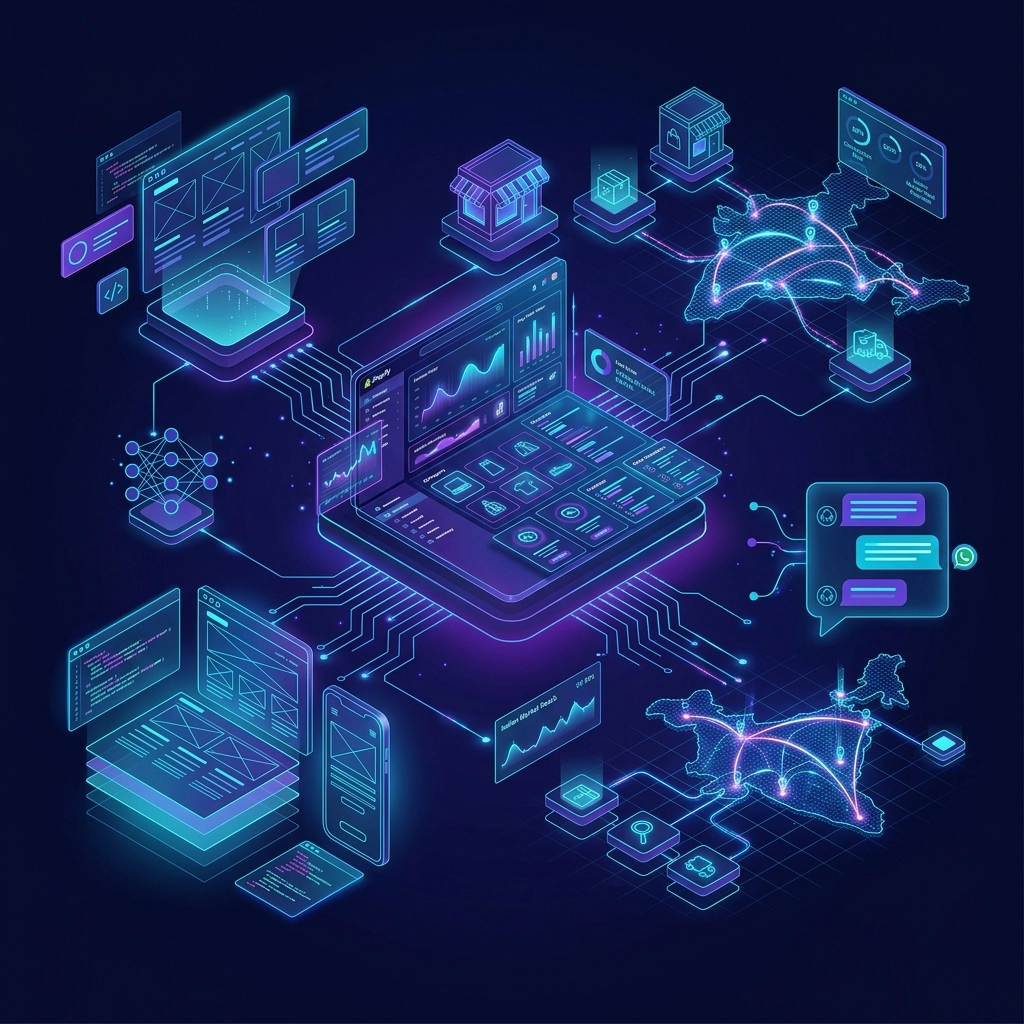
The Indian ecommerce landscape in 2026 is no longer a "frontier" market; it is a $325 billion powerhouse of digital commerce. For businesses looking to scale, the question is no longer whether to enter the market, but how to architect a system that survives the sheer volume and complexity of the Indian consumer base.
As a senior technology partner, we have observed that 95% of ecommerce failures aren't due to poor products, but fragmented systems. When inventory, customer support, and fulfillment act as silos, scaling becomes a liability rather than an achievement. This guide breaks down the engineering requirements for building a robust, high-conversion ecommerce engine in India.
The Architectural Foundation: Beyond the Digital Storefront
Building a store is the easy part. Building a scalable business system is where most firms stumble. In India, where logistical fragmentation and diverse payment preferences are the norm, your ecommerce architecture must be purpose-built for resilience.
Success starts with a deep dive into market intelligence. Before a single line of code is written, we prioritize:
- Defined Niche Analysis: Identifying demand-supply gaps within the Indian market.
- Competitive Systems Audit: Analyzing not just what competitors sell, but how their tech stack handles peak traffic during festive seasons.
- Buyer Persona Mapping: Accounting for the "Next Billion Users" who primarily interact with the internet via mobile devices and voice search.
Failure to integrate these insights into the development phase results in a "leaky bucket" business model where customer acquisition costs (CAC) always exceed lifetime value (LTV).

Selecting the Right Platform: Engineering for Growth
The choice of platform dictates your operational ceiling. In our experience as a leading shopify development company, the choice usually falls into three categories:
1. Shopify: Speed and Reliability
For D2C brands and startups, Shopify offers an unparalleled time-to-market. It eliminates the technical debt associated with server management, allowing brands to focus on marketing and product. However, "out of the box" Shopify is rarely enough for the Indian market. Custom liquid development and API integrations are required to handle local GST compliance and hyper-local delivery partners.
2. Adobe Magento (Commerce): Enterprise Flexibility
For businesses managing complex B2B workflows, multi-store environments, or massive SKU counts, Magento remains the heavyweight champion. It allows for deep customization that off-the-shelf SaaS platforms cannot match.
3. Custom Laravel or Headless Architectures
When your business model doesn't fit a standard mold: such as complex subscription services or multi-vendor marketplaces: a custom build is often the most cost-effective long-term solution. You can read more about how we handle custom web application development for specialized industries.

The AI Advantage: Why an AI Development Company India is Your Best Ally
In 2026, a static ecommerce site is a dead site. The integration of artificial intelligence is the primary differentiator between a catalog and a sales engine. As an ai development company india, we focus on three core AI implementations:
AI-Driven Personalization
Generic recommendations are being replaced by RAG (Retrieval-Augmented Generation) pipelines that understand intent. When a user searches for "summer wedding wear," the system doesn't just show products; it curates an ensemble based on the user's past behavior and current trends.
Intelligent Chatbots and Shopping Agents
The transition from traditional chatbots to AI shopping agents is driving a 30% improvement in conversion rates. These agents handle everything from sizing queries to order tracking. You can explore the comparison between AI agents and traditional chatbots to see which fits your scale.
WhatsApp Automation
In India, WhatsApp is the internet. Integrating a whatsapp-ai-bot.php allows businesses to recover abandoned carts, send shipping updates, and even process payments directly within the chat interface. This reduces friction and leverages the platform where Indian consumers spend 90% of their mobile time.
Why Choose an Ecommerce Development Company India for Global Projects?
The economic logic of partnering with an ecommerce development company india is compelling, but the benefit extends beyond cost. While businesses often see a 65-85% reduction in development costs compared to US or UK agencies, the real value lies in the technical depth.
India has become the global hub for platform certifications. Whether it is Magento, BigCommerce, or Shopify, the concentration of certified talent allows for:
- Rapid Prototyping: Moving from concept to MVP in weeks, not months.
- 24/7 Operational Visibility: Utilizing time-zone differences for continuous development and support cycles.
- System Integration Expertise: Connecting ecommerce fronts to complex ERPs, CRMs, and legacy inventory systems.

The 18-Month Execution Roadmap
Success in ecommerce is a marathon, not a sprint. We advise our clients to follow a phased deployment strategy to ensure stability.
Phase 1: The Core (Months 0-6)
Focus on the MVP. Deploy a clean, mobile-responsive storefront on your chosen platform. Ensure the checkout flow is optimized for Indian payment gateways (UPI, Credit Cards, EMI) and that the Shopify development is compliant with local tax laws.
Phase 2: Operational Excellence (Months 6-12)
This phase is about eliminating manual errors. Integrate your store with warehouse management systems (WMS) and automated shipping aggregators. Deploy AI functionalities to handle the surge in customer support tickets as your traffic grows.
Phase 3: Omnichannel Scaling (Months 12-18)
Connect your online inventory with physical points of sale (if any) and expand into marketplaces like Amazon and Flipkart. Use data orchestration tools to ensure a single source of truth for your inventory across all channels.
Solving the "Scale Paradox"
The "Scale Paradox" occurs when more sales lead to more chaos because the underlying systems weren't engineered for volume. At Unwavering Technology, we eliminate this by treating ecommerce as a system of interconnected workflows.
For instance, 80% of Indian firms are already using AI agents to manage the scale. If your store still relies on manual data entry for order fulfillment, you are not just falling behind; you are building on a foundation of sand.

Metrics That Actually Matter
Ditch the vanity metrics. To succeed in the Indian ecommerce sector, you must monitor:
- Order-to-Delivery Flow Efficiency: How many manual touchpoints exist between a customer clicking "buy" and the courier picking up the package?
- Customer Retention Rate: It is 5x cheaper to keep a customer than to acquire a new one via Meta or Google ads.
- System Uptime and Latency: In a mobile-first market, a 1-second delay in page load can lead to a 7% drop in conversions.
Conclusion: Engineering Your Future
The Indian ecommerce market offers unprecedented opportunities for those who approach it with technical rigor. Whether you are a local brand looking to dominate the domestic market or a global enterprise seeking an efficient ecommerce development company india, the goal remains the same: create a system that is robust, automated, and scalable.
At Unwavering Technology, we don't just build websites; we engineer revenue-generating ecosystems. From Shopify development to advanced AI solutions, we provide the technical backbone your business needs to thrive.
Ready to build a scalable ecommerce system?
Book a free consultation with our experts at Unwavering Technology today.
Leave a Reply