
How to Integrate WhatsApp AI Bots with Shopify to Recover 30% More Abandoned Carts
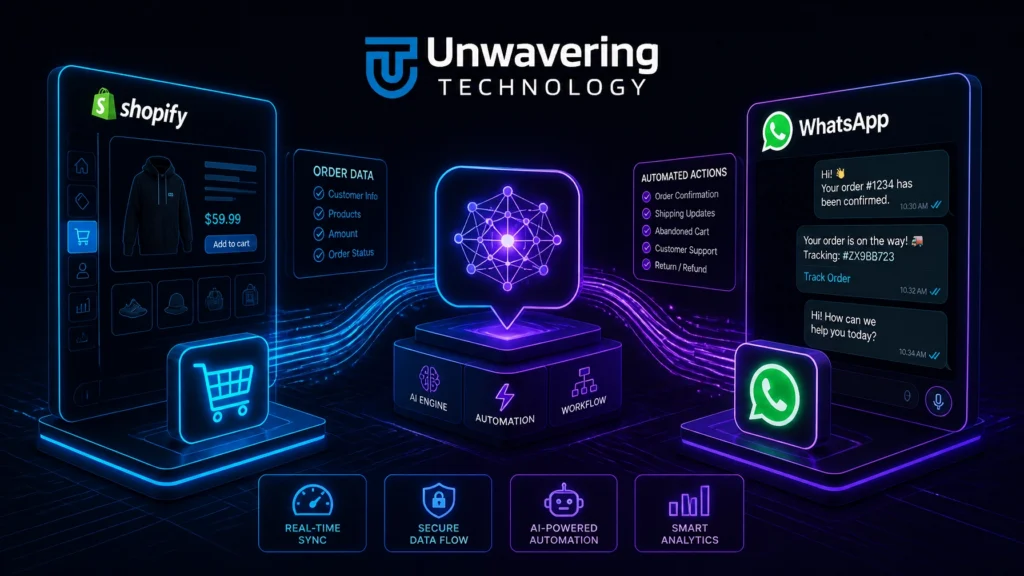
For the modern eCommerce enterprise, the "abandoned cart" is not just a missed opportunity; it is a systemic leak in the revenue funnel. Industry benchmarks reveal that nearly 70% of online shoppers exit the checkout process before completion. While traditional recovery methods: primarily automated email sequences: have been the standard for a decade, their efficacy has plateaued.
As a leading eCommerce development company India, we have observed a critical shift in consumer behavior. Static emails are frequently buried in promotional tabs or ignored entirely, resulting in average recovery rates of just 4% to 6%. To recapture high-intent revenue at scale, businesses are transitioning to conversational automation.
By integrating WhatsApp AI bots with your Shopify ecosystem, you can achieve recovery rates as high as 25% to 30%. This transition represents a shift from passive notification to active, intelligent negotiation.
The Revenue Gap: Why Email Sequences are Failing
The failure of email for cart recovery is a technical and psychological issue. Email is asynchronous and formal. By the time a customer opens a "You left something behind" email three hours later, the impulse to buy has often dissipated, or a competitor has already fulfilled the need.
In contrast, WhatsApp provides a direct, low-friction channel with open rates exceeding 98%. However, simply sending a text notification is not enough. The real power lies in the integration of Artificial Intelligence. Static WhatsApp templates recover roughly 8–12% of carts, but when an AI development company India builds a RAG-powered (Retrieval-Augmented Generation) bot into that flow, the bot can answer objections in real-time, driving the recovery rate toward the 30% mark.

The Technical Architecture of WhatsApp AI Integration
Successfully deploying a WhatsApp AI bot for Shopify requires a robust technical stack. It is not merely about sending a message; it is about synchronizing real-time checkout data with a natural language processing engine.
1. Data Capture and Webhooks
The process begins with Shopify’s checkouts/update or checkouts/create webhooks. When a customer enters their contact information but fails to reach the orders/create state within a specified window (typically 30–60 minutes), Shopify triggers an event. Our engineering team configures these webhooks to pass the customer’s phone number, cart contents, total value, and specific product identifiers to a central automation hub.
2. The WhatsApp Business API (BSP)
Unlike the standard WhatsApp app, the Business API allows for programmatic message dispatch. We utilize Business Solution Providers (BSPs) to secure a verified business profile. This is essential for maintaining high deliverability and ensuring that your messages are not flagged as spam.
3. The AI Logic Layer
This is the "brain" of the operation. Instead of a rigid "if-this-then-that" script, we deploy an AI agent trained on your store’s specific data: product catalogs, shipping policies, and FAQs. When a customer receives a recovery message and replies with a question like "Do you ship to Mumbai?" or "Is the blue version in stock?", the AI provides an immediate, accurate response.

Implementing the 3-Touch Strategic Sequence
As a specialized Shopify development company, we recommend a non-intrusive, three-step sequence designed to convert without damaging brand reputation.
Touch 1: The Diagnostic Inquiry (T+60 Minutes)
The first message should be sent within an hour of abandonment. At this stage, purchase intent is still high. Rather than leading with a discount: which can train customers to abandon carts intentionally: the AI sends a diagnostic message:
"Hi [Name], we noticed you couldn't complete your order for the [Product Name]. Was there a technical issue at checkout we can help with?"
This opens the door for the AI to resolve technical friction or shipping doubts immediately.
Touch 2: The Value Incentive (T+24 Hours)
If the first message does not result in a conversion, the second message introduces a tangible incentive. This could be a limited-time discount code or a "free shipping" offer. The AI logic ensures this is only sent if the user has not already interacted or completed the purchase.
Touch 3: The Scarcity/Closing Message (T+72 Hours)
The final touchpoint emphasizes urgency. "Your cart is about to expire, and we cannot guarantee stock for [Product Name] after today." This final nudge often captures the remaining 5–7% of hesitant buyers.

Engineering the Integration: A Step-by-Step Guide
For enterprises looking to scale, a manual setup is insufficient. Here is the technical roadmap we follow at Unwavering Technology:
- Phone Collection Optimization: We modify the Shopify checkout settings to ensure the phone number field is required and set to "International" format. This ensures the data passed to the WhatsApp API is valid.
- Meta-Approved Templates: WhatsApp requires all business-initiated messages to be pre-approved. We design templates that include dynamic variables (e.g.,
{{customer_name}},{{cart_url}}) to ensure every message feels personalized. - Knowledge Base Training: We ingest your store’s shipping tables, return policies, and product descriptions into the AI's vector database. This allows the bot to provide "human-level" assistance 24/7.
- Human-in-the-Loop Escalation: While the AI handles 95% of queries, complex scenarios (like custom B2B quotes) are automatically escalated to your live support team via a shared inbox, ensuring no high-value lead is lost.

Operational Impact and ROI
The transition to an AI-driven recovery system is not just about a higher percentage of "recovered carts." It is about operational efficiency and data visibility.
- Reduction in Support Tickets: Because the AI answers FAQs within the WhatsApp thread, your support team sees a significant drop in basic "Where is my order?" or "What are the shipping costs?" tickets.
- Customer Insights: The AI logs why people are abandoning. If 40% of customers tell the bot "shipping is too expensive," you have the data-driven evidence needed to adjust your logistics strategy.
- Scalability: Unlike human agents, an AI bot can handle 10,000 simultaneous conversations during a Black Friday or Diwali sale without a drop in response time or quality.
Why Partner with Unwavering Technology?
Building a high-performance recovery system requires more than just a Shopify app installation. It requires a partner who understands the intersection of AI solutions and eCommerce architecture.
At Unwavering Technology, we don't just "connect" tools; we engineer systems. We ensure that your WhatsApp AI integration is compliant with Meta’s strict policies, optimized for the Indian and global markets, and deeply integrated into your existing CRM and ERP systems.
If your Shopify store is losing 70% of its potential revenue to abandoned carts, it is time to move beyond the limitations of email. We help you deploy intelligent, responsive, and high-converting automation that turns lost sessions into loyal customers.
Drive your recovery rates higher. Book a consultation with our AI and eCommerce experts today.
Leave a Reply