
The Proven 95-Day Framework to Scale Your Store with AI Powered eCommerce Solutions
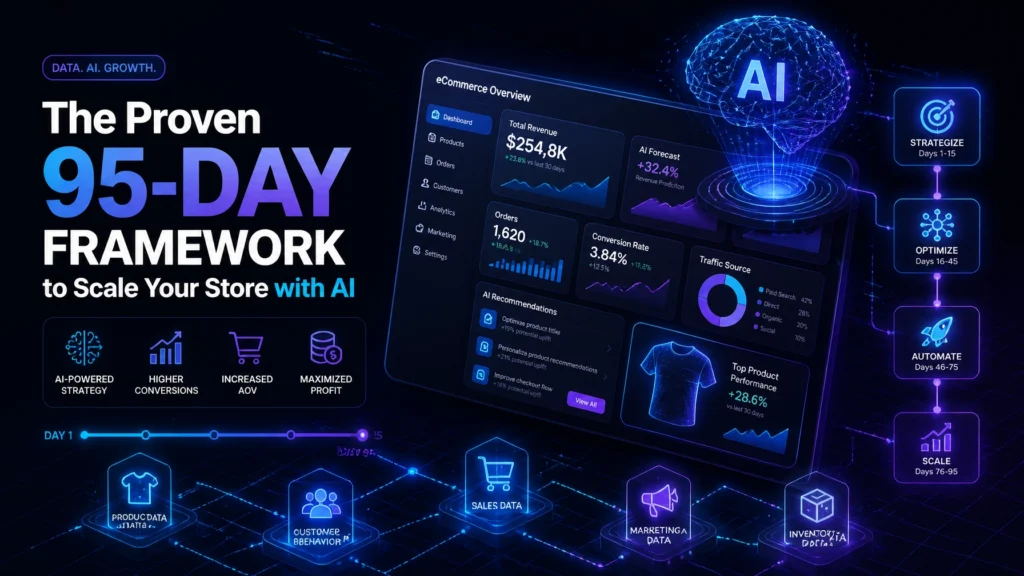
For many growing brands, the transition from a steady revenue stream to an exponential scale-up is often met with operational paralysis. As order volumes increase, manual workflows that once sufficed: from inventory management to customer support: become significant liabilities. Without a systemized approach to integration and intelligence, more sales inevitably lead to more chaos.
At Unwavering Technology, we recognize that scaling is not merely about increasing traffic; it is about engineering a resilient infrastructure capable of handling volume without a linear increase in overhead. As a premier ai development company india, we have developed a structured 95-day framework designed to transform legacy operations into high-performance, AI-driven ecosystems.
This guide outlines the tactical roadmap for retailers looking to leverage advanced ecommerce solutions to eliminate bottlenecks and capture missed revenue.
Phase 1: Days 1–30 – Engineering the Data Foundation
The intelligence of any AI system is limited by the quality of the data it consumes. Many brands operate in silos, where inventory data is disconnected from marketing, and customer support lacks visibility into the order-to-delivery flow. The first 30 days are dedicated to auditing, cleaning, and centralizing your technical architecture.
Audit and Architectural Alignment
We begin by evaluating your existing tech stack. Whether you are currently utilizing legacy systems or looking to migrate, selecting a scalable platform is critical. As a specialized shopify development company, we often recommend Shopify for its robust API ecosystem and its ability to handle high-traffic surges. During this phase, we map every data touchpoint: from your WMS/ERP to your CRM: ensuring that information flows seamlessly across the organization.
Data Normalization and Enrichment
AI-driven recommendations and search algorithms require highly structured product data. We implement automated workflows to normalize titles, attributes, and categories. By enriching your product catalog with AI-assisted tagging, we ensure that your internal search engines and recommendation widgets can accurately match products to user intent from day one.
Establishing the Performance Baseline
Scaling requires measurable metrics. Before deploying automation, we establish KPIs across three core pillars:
- Revenue & CX: Conversion rates, Average Order Value (AOV), and Net Promoter Score (NPS).
- Operational Efficiency: Tickets per order and manual catalog update time.
- Inventory Health: Stockout frequency and days-on-hand for high-margin SKUs.

Phase 2: Days 31–60 – Deploying AI Integration and Workflow Automation
With a stabilized data foundation, the focus shifts to deploying intelligent systems that replace manual intervention. This phase is about increasing the "velocity of commerce" by automating routine tasks and personalizing the customer journey at scale.
Implementing AI-Driven Customer Engagement
Customer support is often the first department to buckle under the weight of rapid growth. We deploy sophisticated whatsapp-ai-bot.php solutions that handle up to 60% of routine inquiries, including order tracking, return requests, and product FAQs. By integrating these bots directly with your eCommerce platform, we provide customers with instant, accurate responses 24/7, significantly reducing the burden on your live support team.
Intelligent Workflow Orchestration
We automate the "hidden" tasks that slow down your operations. This includes:
- Dynamic Merchandising: Automatically promoting high-margin or overstocked items based on real-time inventory levels.
- Automated Lifecycle Marketing: Triggering personalized cross-sell and win-back campaigns using AI models that predict the optimal time to re-engage a customer.
- Catalog Automation: Utilizing AI to generate SEO-optimized product descriptions and meta-tags, ensuring your new arrivals are indexed and ready for sale within minutes, not days.
Real-Time Inventory Visibility
Manual inventory tracking is a recipe for stockouts or capital-heavy overstocking. We integrate AI-driven early-warning systems that monitor sales velocity and alert your procurement team when high-revenue SKUs approach critical levels. This proactive approach ensures that your marketing spend is always directed toward products that are actually available for fulfillment.

Phase 3: Days 61–95 – Predictive Scaling and Revenue Optimization
In the final phase of the framework, we move from reactive automation to predictive intelligence. This is where your store transitions into a self-optimizing engine that anticipates market trends and customer behavior.
Advanced Demand Forecasting
Using historical sales data, seasonal trends, and marketing forecasts, we implement RAG (Retrieval-Augmented Generation) pipelines and predictive models to forecast demand at the SKU level. This allows for precise inventory planning and reduces the "bullwhip effect" in your supply chain. As a leading ecommerce development company india, we specialize in building these custom analytical layers on top of existing platforms like Shopify and WooCommerce.
Hyper-Personalization and Dynamic Pricing
Generic discounts are margin-killers. We deploy AI-powered personalization engines that tailor the entire shopping experience: from the homepage layout to the individual pricing offers: based on a customer’s lifetime value and purchase probability. Dynamic pricing models can then adjust based on demand, competitor activity, and inventory health to maximize both volume and margin.
Scaling Without Proportional Headcount
The ultimate goal of this 95-day framework is to decouple revenue growth from headcount growth. By the end of this period, your business should be capable of handling a 2x or 3x increase in order volume with the same operational staff. The combination of AI Solutions and robust eCommerce Solutions creates a platform that is inherently scalable, flexible, and resilient.

Why Strategy Matters More Than Software
A common mistake in digital transformation is viewing AI as a "plugin" rather than a fundamental architectural shift. Scaling an eCommerce store requires a systems-thinking approach where every component: from the frontend user experience on Shopify to the backend logistics: is interconnected and data-informed.
At Unwavering Technology, we don't just provide features; we engineer outcomes. Our 95-day framework is built on proven methodologies that have helped enterprises across India and the US streamline their operations and recapture lost revenue.
Key Outcomes of the 95-Day Framework:
- Up to 45% reduction in manual data entry and catalog management errors.
- 30% improvement in customer support efficiency through AI automation.
- Significant reduction in stockouts and overstock costs through predictive forecasting.
- Measurable lift in Conversion Rate and AOV through deep personalization.
Take the Next Step in Your Scaling Journey
The difference between a store that plateaus and one that scales is the willingness to replace outdated manual processes with intelligent, automated systems. Whether you are a high-growth startup or an established enterprise, the time to build your AI foundation is now.
Ready to engineer your scale-up?
Consult with the senior technology partners at Unwavering Technology. Let’s discuss how we can implement a custom AI and eCommerce roadmap tailored to your specific operational needs.
Leave a Reply