The Ultimate Guide to Custom AI Agent Development: Scaling Your Business Without Increasing Headcount
Operational scaling has traditionally followed a linear path: to handle more customers, process more orders, or manage more inquiries, a business must hire more people. This model is inherently flawed. In high-growth environments, the cost of recruitment, onboarding, and management often erodes the very margins that growth was supposed to provide. When internal systems are fragmented, more sales simply create more chaos.
At Unwavering Technology, we recognize that true scalability is no longer a human-resource challenge: it is an architectural one. Custom AI agents represent the shift from manual execution to autonomous orchestration. These are not simple chatbots; they are goal-oriented digital entities engineered to reason, use tools, and execute complex workflows across your existing tech stack.
The Operational Bottleneck: Why Manual Growth Fails
In industries ranging from manufacturing to retail, the reliance on human intervention for repetitive cognitive tasks creates a "productivity ceiling." When your team spends 40% of their day reconciling data between an ERP and a CRM, or manually answering the same shipping queries on WhatsApp, your business isn't just slow; it’s vulnerable.
Errors in manual data entry, delayed responses in lead generation, and inconsistent customer support lead to churn and lost revenue. To break this ceiling, enterprises must deploy AI solutions that function as a force multiplier. By integrating custom AI agents, organizations can achieve a 30% to 50% improvement in process efficiency within the first two quarters of deployment.
What Defines a True AI Agent?
Before embarking on development, it is critical to distinguish between traditional automation (if-then logic) and AI agents. A traditional system follows a rigid script. An AI agent, powered by Large Language Models (LLMs) and context-aware frameworks, follows a goal.
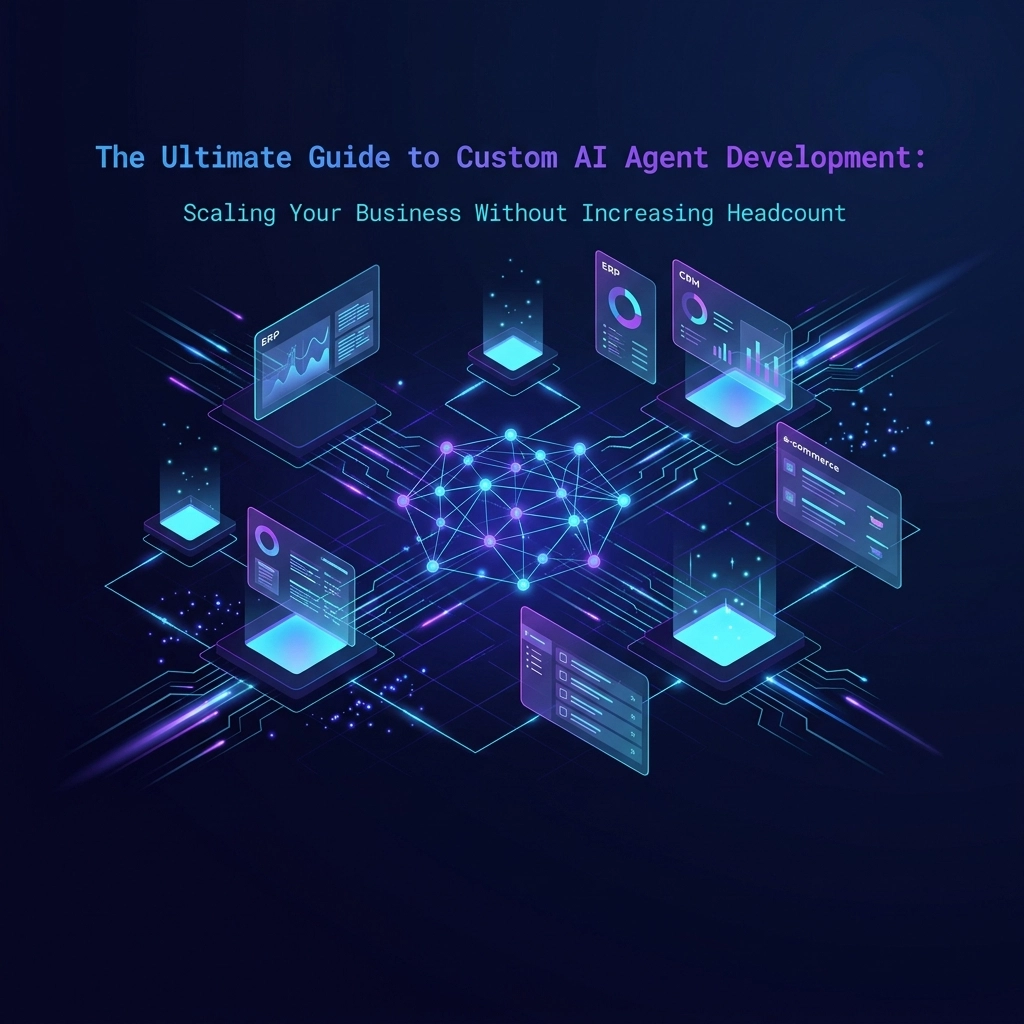
A robust AI agent architecture consists of four primary pillars:
- The Brain (Model): The reasoning engine, such as GPT-4, Claude 3.5, or specialized open-source models, that interprets instructions and makes decisions.
- The Hands (Tools): API integrations that allow the agent to interact with your Shopify store, send emails, query databases, or update inventory.
- The Memory (Context): A Retrieval-Augmented Generation (RAG) pipeline that provides the agent with access to your proprietary business data, ensuring its outputs are grounded in reality.
- The Guardrails (Instructions): Explicit behavioral parameters that define the agent’s scope, tone, and safety protocols.

Strategic Use Cases: Scaling Without the Overhead
1. eCommerce Workflow Orchestration
For a growing brand, managing order-to-delivery flows is a high-touch process. A custom AI agent can monitor inventory levels across multiple warehouses, automatically negotiate with logistics partners when delays are detected, and update customers via a WhatsApp AI bot. As an experienced ecommerce development company india, we design these agents to sit between your storefront and your warehouse, eliminating the need for a dedicated "order management" team.
2. Autonomous Lead Qualification
In professional services and real estate, the speed of lead response is the primary predictor of conversion. Instead of waiting for a sales rep to wake up, an AI agent can engage a lead at 3 AM, qualify them based on your specific criteria, and book a meeting directly into your calendar. This transforms your website from a passive brochure into an active sales generator.
3. Supply Chain & Logistics Monitoring
In manufacturing, AI agents can analyze sensor data or shipping manifests in real-time. If a raw material shipment is flagged for a customs delay, the agent can autonomously re-route production schedules and alert the procurement team, preventing a total operational standstill.

The Development Roadmap: From Assessment to Deployment
Building a production-ready AI agent requires more than just a prompt. It requires a systems-thinking approach to ensure the agent integrates seamlessly with your business system integration.
Phase 1: Business Assessment & Workflow Mapping
We begin by identifying the specific "friction points" in your current operations. We don't automate for the sake of technology; we automate for the sake of the bottom line. This involves a deep dive into your existing ecommerce solutions and internal workflows to pinpoint where human headcount is being wasted on low-value tasks.
Phase 2: Architecture Design & Framework Selection
Depending on the complexity, we select the right orchestration framework.
- LangChain: For agents requiring deep reasoning and complex tool-use sequences.
- CrewAI: For multi-agent systems where specialized agents (e.g., a "Researcher" and a "Writer") collaborate on a single goal.
- n8n/Zapier: For lighter workflow orchestration that connects legacy apps.
Phase 3: RAG Pipeline Implementation
Generic AI is dangerous for business. To make an agent effective, we build a RAG pipeline that feeds it your specific product catalogs, company policies, and historical data. This ensures the agent doesn't "hallucinate" and provides accurate, brand-aligned information every time.
Phase 4: Prototyping and Iterative Testing
We deploy a MVP (Minimum Viable Product) in a sandboxed environment. Here, we run "unit tests" for the agent’s tools and "integration tests" to ensure it communicates correctly with your CRM or ERP. As a leading ai development company india, our focus is on reliability and safety: ensuring the agent never operates outside its intended scope.

Why Indian Expertise is the Secret to Scalable AI
Partnering with an ai development company india like Unwavering Technology provides a strategic advantage. India has become the global hub for AI engineering, offering a unique combination of deep technical expertise in frameworks like Python, Node.js, and PyTorch, alongside a cost-efficient model that allows for rapid prototyping and scaling.
Our team doesn't just write code; we engineer outcomes. Whether you are a US-based retailer looking for a shopify development company to automate your back-office or a European logistics firm needing a custom RAG solution, we provide the technical depth required to build systems that scale.
Overcoming the "Black Box" Problem: Transparency and Control
A common concern for CEOs and COOs is the loss of control when deploying autonomous agents. We solve this through "Human-in-the-Loop" (HITL) configurations.
- Threshold Approvals: The agent can execute tasks autonomously up to a certain confidence score or dollar value. Above that, it flags the task for human review.
- Comprehensive Logging: Every decision the agent makes is logged, providing full operational visibility and an audit trail for compliance.
- Performance Monitoring: We track metrics such as "Resolution Rate," "Average Response Time," and "Task Success Rate" to ensure the AI is delivering a measurable ROI.

Scaling the Future of Your Enterprise
The goal of AI agent development is not to replace your team, but to liberate them. By delegating the "robotic" work to robots, your human capital can focus on strategy, creativity, and high-value relationship building. When inventory, fulfillment, and customer communication are connected through an intelligent agent, your business becomes a self-optimizing system.
As your business grows from 1,000 orders a month to 100,000, your headcount shouldn't have to follow the same trajectory. That is the power of purpose-built AI.
Engineered for Growth, Built for Stability
Unwavering Technology specializes in the design, development, and deployment of custom AI solutions that solve real operational failures. From eCommerce architecture to complex business system integrations, we provide the infrastructure that allows you to scale with confidence.
Stop hiring for roles that can be automated. Start building the digital workforce of the future.
Leave a Reply